Perceptual
constancy is our tendency to see familiar objects as having a constant
shape, size, and colour, regardless of any changes in perspective, distance, or
lighting that they undergo. Our perception of these objects under such changing
conditions is much closer to the general image of them that we have memorized
than to the actual stimulus reaching our retinas. Thus, perceptual constancy is
what lets you recognize a plate of vegetables, for instance, regardless of whether
you are looking down on it at your own table, or noticing it on someone else's
table in front of you in a dark restaurant, or seeing it in side view on a huge
billboard several dozen metres away from you as you drive past it in broad daylight.
French psychologist Jean Piaget showed that this perceptual constancy
is far from innate and is learned in childhood. As children learn how to grasp
objects, they form an idea of the objects' size and distance, and as children
move around, they learn to recognize objects from various angles and under various
light conditions.
WHAT OPTICAL ILLUSIONS SHOW US ABOUT VISUAL
PERCEPTION
The human visual system
analyzes the interactions between visible electromagnetic waves and the objects
in our environment, extracts information about the world from them, and makes
visual perception possible. Visual perception is considered a dynamic process
that goes far beyond simply replicating the visual information provided by the
retina.
To perceive is to create a figure or shape that does not necessarily
appear as such in the real world but that we can represent mentally so that we
can recognize it under various conditions (for instance, when it is partly hidden).
Hence, by studying the way that the brain fills in missing or ambiguous visual
information, we can learn a lot about the way that we perceive the world. Optical
illusions provide fertile ground for such study, because they involve ambiguous
images that force the brain to make decisions that tell us about how we perceive
things.
Most optical illusions result
from processes in the cortex, but some do originate in the retina.
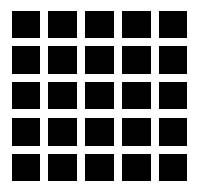
One such illusion is the Hermann grid shown here, in which gray spots appear at
the intersections of the rows and columns created by the squares, because of a
phenomenon called lateral retinal inhibition. If you stare
directly at one of these intersections, however, the gray spot disappears, and
it looks white, because then you are using the cells of the fovea, which do much less correction
for an area's surroundings.
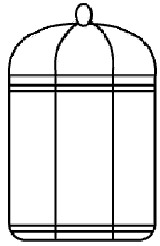
Here is another example of an illusion of retinal origin.
Look at the bird for about 20 seconds, then look at the cage: the bird's silhouette
will appear inside it, in red. The reason this time is the cones, the colour-sensitive receptors in the retina.
As you stare at the bird, the green cones covering its shape on your retina gradually
become desensitized, so that the other cones begin to dominate. When you then
look at the cage, with its white background, a red bird appears, because the white
minus the green creates a reddish light. This image that persists when you stop
looking at an object is called a residual image.
Despite appearances, these two circles
are the same shade of grey (place your mouse cursor over either image to prove
it).
These
two circles are the same colour, even though the one on the blue background seems
reddish and the one on the red background seems bluish (if you don't believe it,
place your mouse cursor over the picture). Thus the background effect also influences
colour perception.
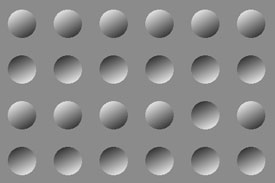
Because the human visual system interprets
lighting as coming from above, we perceive the spheres whose upper part is brighter
as emerging from this image, and the spheres whose upper part is darker as receding
into it.
The same phenomenon also applies to
the apparent brightness of a surface, which depends not only on its own luminance
but also on the luminance of the areas surrounding it. As shown here, given two
circles that are the same shade of grey, the one placed on a dark background will
look lighter and the one placed on a light background will look darker. One explanation
often offered for this phenomenon is that the brain thinks of the circle on the
dark background as a light disc in a dimly lit location, and the circle on the
light background as a dark disc in a brightly lit location. This would suffice
to make the two circles appear to be different shades of grey even though they
are not.
Another way to explain this phenomenon is to think of our perception
as being adapted to past surrounding stimuli, so that they constitute a sort of
baseline from which subsequent stimuli are perceived—a bit like the profound
silence you perceive when the refrigerator suddenly stops running. What you were
perceiving as silence before the refrigerator stopped was actually the steady
humming that you have gotten used to.
The lighting of a scene is an important factor
that the visual system considers to help it identify objects. As soon as you interpret
a visual object as possibly being three-dimensional, your visual system immediately
tries to determine where the light is coming from, then uses this information
to decode the object's properties.
The
most disturbing optical illusions often combine several phenomena all working
in the same direction to accentuate the error of interpretation that the visual
system is making. In Adelson's checkerboard, below, you would swear that squares
A and B were black and white, but they're actually the same shade of grey. Here's
how it works.
First
of all, there is an illusion of context (see above). Square A is surrounded by
light squares, which make you perceive it as darker. Conversely, square B is surrounded
by dark squares, which make you perceive it as lighter. Meanwhile, your eyes automatically
interpret the darker area to the left of the cylinder as a shadow, because the
gradations of green on the cylinder suggest that a light source to its right is
making it cast a shadow to its left. On the basis of past experience, your visual
system assumes that square B would actually be brighter in full light, since even
in "shadow" it seems brighter than the squares surrounding it.
This illusion ultimately works
because every square is surrounded by a well defined "X" structure consisting
of four other squares, which strongly indicates to your visual system that the
square at the centre must be interpreted as a change in the colour of the surface
itself, and not a change caused by differences in light or shadow.
Far
from demonstrating the faults in the human visual system, these phenomena actually
reveal the powerful mechanisms of discernment that let us isolate and identify
objects among the myriad confusing shapes in the real world.
There are many illusions in which you
perceive a figure standing out from its background even though this subjective
image has no lines defining its boundaries and displays no differences in brightness
that would let you isolate it from its surroundings.
Once again, the
visual system is not passive. It automatically extends line segments into parts
of the drawing where they are missing, so that your mind imagines that an object
has been placed over the abstract shapes and lines in the drawing. The perception
of such contourless figures thus reflects some innate properties
of the way the visual system is wired.
In another category of
illusions that rely on the subjectivity of contours, the figure can become the
background, and vice versa. The psychologists who developed Gestalt theory created
many such images in which the figure/ground relationship is ambiguous.
These images demonstrated the central tenet of Gestalt theory: that the whole
has global properties different from those derived from the sum of its parts.
In the first, classic example shown to the right here, two profiles
facing each other delimit a space that can be seen as a goblet, and your perception
can alternate between the profiles and the goblet. If you focus most of your attention
on the light part of the image, you will perceive that part as the figure and
automatically see the dark part as simply the background. The reverse is also
true. Thus, perceiving one figure prevents you from perceiving the other.
It thus seems that to interpret a complex image, your brain has to identify
a main figure and relegate the rest of the image to the background. Such illusions
clearly demonstrate how your visual system groups and separates the characteristics
of a complex image in order to recognize objects within it. Some facetious artists take advantage
of these necessary associational mechanisms of perception to leaves two possibilities
open, each of which is just as plausible as the other.
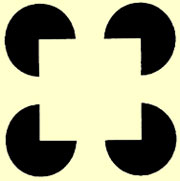
Because the missing
quarters of these 4 discs all face inward, they create the perception of a square
with a subjective contour.
A circle seems
to have been placed on top of these converging lines, even though there is no
contour defining this circle.
Two profiles,
or a goblet?
A saxophone player,
or a woman's face?
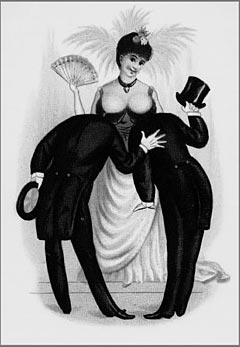
What's showing
here, the gentlemen's scalps, or the lady's bosom?
Your visual system takes
two-dimensional images projected onto your two retinas and uses these images to
reconstruct a three-dimensional perception of the world around you. To perceive
the depth in a visual scene, your visual cortex relies on two kinds of
information: the information that your binocular vision provides by integrating
the two slightly different images from your two eyes, and the information that
your monocular vision provides from the image perceived by each eye separately.
When an object is close up, you rely mainly on the disparity between the
two images perceived by your two eyes—in other words, on your binocular
vision. The reason is simply that the closer an object is to your eyes,
the greater the difference in the angles from which your two eyes view it.
But even with monocular vision, you can receive an impression
of depth, because your brain deduces it from several indicators.
-
Interposition is certainly the most common depth indicator. Whenever
one object hides your view of another object either partly or completely, your
brain deduces that the hidden object is farther away, simply because the other
object is in front of it.
- Atmospheric perspective
is created by the dust particles and water vapour in the air, which cause objects
to seem dimmer and blurrier the farther away they are.
- Texture gradients
appear when you look at surfaces from a certain angle; the texture seems to become
denser and less detailed as your eye moves toward the part of the surface that
is farthest from you.
- Object size is another depth
indicator that your brain refers to constantly. When you don't know the exact
size of two objects, but you do know that they are identical, and one of them
projects a smaller image on your retina, you interpret it as being farther away.
In other words, you judge the two objects' relative size. Similarly, if you are
very sure of the size of a familiar object, you use its size as a reference to
estimate its distance, since you know that the smaller it appears, the farther
away it is.
- Parallax movement occurs when when you
are in motion yourself, and objects that are at different distances from you appear
to be moving at different speeds. The farther away these objects are, the smaller
the parallax movement.
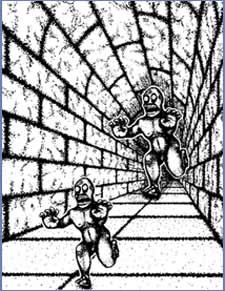
Despite
appearances, the monster being chased is the same size as the one doing the chasing.
Don't believe it? Place your mouse cursor over the picture.
The first involves drawings like the one to the left, where
two identical objects are placed along converging lines that imply perspective.
The two monsters in this picture are the same size, so the two images that they
make on your retina are the same size too. But because your brain assumes that
the monster who is closer to the virtual horizon must be farther away, your brain
also assumes that this monster must be larger, in order to create the same size
image on your retina.
The other exception involves heavenly bodies such
as the Moon, which create the well known illusion of the Full Moon
appearing larger when it first comes up over the horizon.
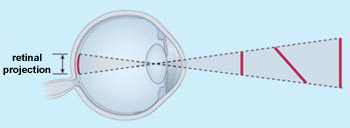
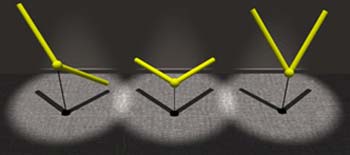
One
important source of ambiguity for the visual system is that the world is three-dimensional,
but the images that it projects onto your retina are two-dimensional. Hence differing
objects, depending on their distance and orientation, may occupy the same amount
of surface area on your retina. Your brain therefore becomes confused, and tries
to use other indicators to clarify the situation. Two such indicators are your
own past experience with the object
in question and the experience
of the human species, which is encoded in your genes.
A
given angle projected on the retina may come from various objects at various angles,
of varying lengths, and with varying orientations in space.