One
of the most common optical illusions is the Full Moon, which looks so
enormous when it first comes up over the horizon. This is clearly a
misinterpretation on the brain's part, because the Moon is 385 000 km from Earth
and therefore always covers the same number of degrees of arc on the retina—about
0.5—whether it is at the horizon or directly overhead.
Since the
image formed on the retina is thus always the same, it is the presence of the
horizon close to the disc of the Moon that makes us perceive it as larger. To
prove this to yourself, cut a hole in a piece of paper, then close one eye, hold
the paper up to the other, and look through the hole at the rising Moon while
blocking your view of the horizon. The Moon will look much smaller—so much
smaller that if you open your other eye, which can see the horizon as well as
the Moon, your two eyes will each see a different-sized Moon!
From experience,
we know that a cloud, an airplane, or a tree will seem smaller if it is near the
horizon than if it is overhead. This rule applies to all the objects that we deal
with on Earth. Our visual apparatus seems to have been shaped by evolution
on the basis of this reality, so that we are at a loss when we have to interpret
an object like the Moon, which is so far away that it occupies the same amount
of area on our retina regardless of whether it is near to or far from the horizon.
When the Moon is near the horizon, the brain may tell itself that if this object's
image doesn't become smaller near the horizon, then it must be really big, and
the brain then makes us perceive the Moon accordingly.
Another way to
explain this is to say that to the brain, the default distance to an object is
always less than the distance to the horizon. Of course, the brain applies this
rule to terrestrial objects, since these are the only ones it knows, except for
the Moon and the Sun. The distance to these two heavenly bodies does not vary
whether they are at the horizon or the zenith, which confuses our visual systems.
Some refinements to this explanation have been proposed, and the psychological
mechanisms that cause this illusion with the Moon are still being debated.
WHAT OPTICAL ILLUSIONS SHOW US ABOUT VISUAL PERCEPTION
Mechanisms that cause
optical illusions have been located in various places along the nervous system's
visual pathways. Some of these mechanisms arise in the retina, but most of them result
from the way that the images captured with the eyes are reconstructed by the visual cortex (see box below).
Contrary
to what we intuitively believe, the information presented by our senses does not
actually correspond to reality directly. With vision, for example, the image striking
the retina contains vastly more information than is actually transmitted to the
brain by the optic nerve. This makes sense, when you consider that the 125 million
photoreceptors in each retina converge onto
100 times fewer ganglion cells.
To compensate for
this massive loss of information and provide us with visual perceptions that are
rich in contrast, colour, and movement, the brain introduces abstract parameters
that often fill in or amplify the fragments of reality that it is given to work
with. The brain's powers to interpret visual information in this way are so great
that it sometimes creates an impression of coherence where there is none—in
other words, an optical illusion.
In geometric optical
illusions, there is generally an "inducing element" that causes the
misinterpretation and a "test element" that is the subject of it. For
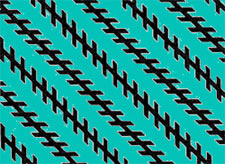
example, in Zöllner's illusion (right), the small vertical and horizontal
lines are the inducing element and the long diagonal lines are the test element.
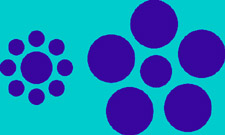
In the size-relationship illusion, the proximity
of a test element to larger inducing elements causes the size of the test element
to be underestimated. The opposite occurs with smaller inducing elements, which
cause the size of a test element to be overestimated. The result is that though
two test elements are identical, they can look different to us, because of the
context effect.
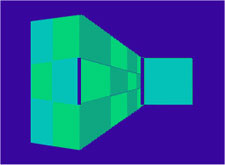
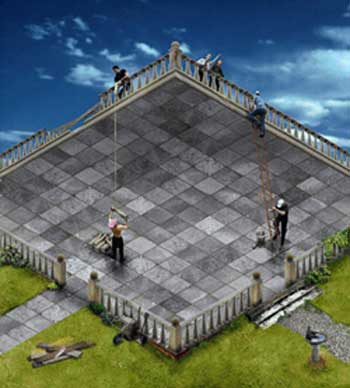
The presence
of lines suggesting perspective can also create size illusions.
Given two objects of equal size, if one of them looks farther away because of
perspective, we will perceive it as being larger.
In
Zöllner's illusion, the long lines are parallel even though they look as
if they would intersect one another if they were extended. (If you don't believe
it, place your mouse cursor over the picture.) The reason for this illusion is
that the brain tries to bring the angles between the short lines and the long
ones closer to 90°, thus "tilting" the lines toward one another.
Place
your mouse cursor over this picture, and you'll see that the two central circles
are actually the same size.
The
effective of perspective is strengthened here by the checkerboard pattern, which
your brain uses to estimate the size of the two vertical lines. Place your mouse
cursor over this picture, and you'll see that these two lines are actually the
same height.
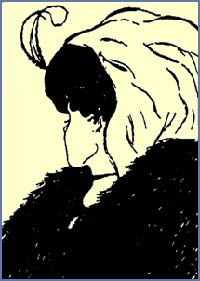
Two incompatible
viewpoints cleverly combined in one drawing.
Young woman or
old woman? The young woman's chin is the old woman's nose, and the old woman's
eye is the young woman's ear.
Some artistic optical illusions are constructed by combining
two different drawings that lead to incompatible interpretations.
Other
artistic optical illusions involve ambiguity, so that a drawing can be visually
interpreted in at least two ways that are mutually exclusive. Once an observer
has identified the markers for the various possible interpretations, he or she
can move among them at will. These kinds of illusions in which the observer goes
back and forth between two interpretations of the same image are similar to illusions in which the figure and the background
are interchangeable.
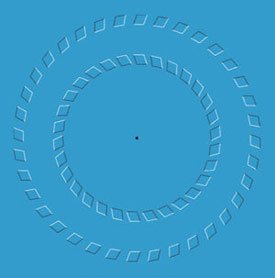
Motion illusions
are another major category of optical illusions . Some images can give the illusion
that their elements are moving when you move yourself slightly relative to them.
In the image here, for example, if you stare at the centre dot, then move your
head in toward the screen, the two circles will start to seem as if they are turning
in opposite directions.
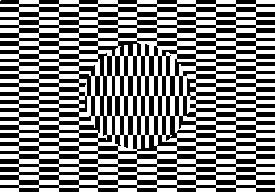
For other motion illusions, you don't even have to move. The particular arrangement
of the graphic elements in the picture suffices on its own to create the appearance
of movement as you look at it. That is what happens in the figure here, because
the pattern makes it hard for your eye to determine the contours of the circle
in the centre.
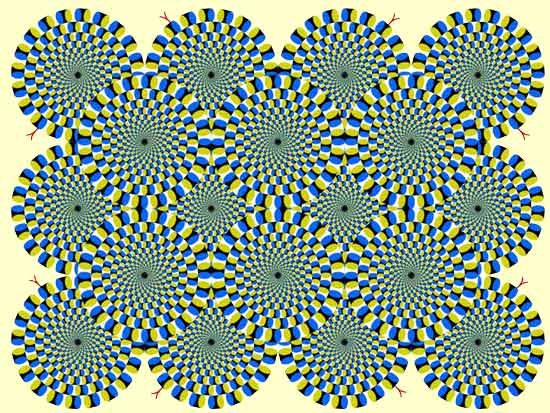
In
the image below, the illusion that some of the wheels are turning occurs only
in your peripheral vision: as soon as you look straight at one of the wheels,
it holds still, but the wheels that are peripheral to it keep turning. Though
this illusion has not been fully explained, we do know that the order in which
the four areas of differing colour and brightness are placed is decisive. More
specifically, the illusory movement seems to occur from black areas to adjacent
areas that are dark but brighter than the black ones (here, the blue areas), or
from white areas to adjacent areas that are coloured but not so bright as the
white ones (here, the yellow areas).
Source: Akiyoshi Kitaoka, Department of
Psychology, Ritsumeikan University, Kyoto, Japan
In other
circumstances, we can perceive motion when we are simply shown two or more stationary
images with a short enough time interval between them. One familiar example of
this kind of illusion is the beta effect. In its simplest form,
it occurs when an observer who has no reference markers is alternately shown two
points of light that are slightly separated from each other (when one point goes
dark, the other lights up).
Geometric illusions do not arise from
the retina, because they appear almost as clearly when the inducing element is
placed in front of one eye and the test element in front of the other. This indicates
that these illusions arise at the point where the information from the two eyes
converges for the first time, beyond the lateral geniculate nucleus, in the visual cortex.