| |
| |
 |
| Making a Voluntary Movement |
|
| | |



Our
Mirror Neurons Prefer the Movements We’ve Already Learned
When you cross a street, you unconsciously
modulate the length of your last few strides as you reach the other side, so that
when you get to the curb, you are just the right distance to step up onto the
sidewalk easily.
Stability in the basic motor pattern for walking is
a necessary condition for the expression of such modulations, whether they are
reflexive or cognitive. Patients with neurological disorders that disturb the
stability of their stride have much more trouble in making such adjustments to
their environment. |
Reaction time is
the delay between the time that a signal is given and the time that an action
is taken in response to it. We see fast reaction times, for example, when a hockey
goalie blocks a sizzling slapshot, or when someone catches a vase as it is falling
off the table. We often say such people have "good reflexes", but that
description isn't really accurate. A reflex
is an involuntary, stereotypical reaction, whereas these responses
by people with very short reaction times are voluntary movements adapted to particular
situations.
Through training, people can reduce their reaction times
by teaching their nervous systems to anticipate such things as the possible path
of a hockey puck or a baseball. But this improvement in reaction time for a specific
task cannot be generalized to all activities. For instance, if a ball rolls out
in front of a car, the time that it takes the driver to hit the brakes will be
just the same (about one second) regardless of whether that person is a star goalie
or someone who is not athletic at all. Also, some substances, such as alcohol,
increase reaction time in all human beings, whereas others, such as caffeine,
reduce it slightly. | | |
| MENTAL IMAGING OF BODY MOVEMENTS | | The brain's first and
foremost function is to enable your organism
to act in its environment so as to ensure its survival. But this environment
is constantly changing, and your actions must constantly adapt to it. To learn
a new action, you must repeat it a certain number of times to encode it in your
procedural
memory. This repetition is what is commonly called training or practicing. 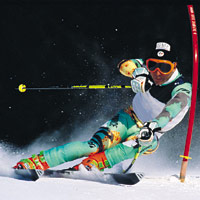 But
there is another way to improve your execution of a movement once you have memorized
the general set of gestures involved, and that is by simply rehearsing the movement
mentally. This process, known as "mental imaging", is commonly used
by top athletes to try to shave those precious fractions of a second off their
times. Downhill skiers, for example, mentally rehearse their entire path down
the race course before they start their descent. They see every turn, feel their
body pass over every bump, and mentally perform all the manoeuvres required to
race their way down the hill. But
there is another way to improve your execution of a movement once you have memorized
the general set of gestures involved, and that is by simply rehearsing the movement
mentally. This process, known as "mental imaging", is commonly used
by top athletes to try to shave those precious fractions of a second off their
times. Downhill skiers, for example, mentally rehearse their entire path down
the race course before they start their descent. They see every turn, feel their
body pass over every bump, and mentally perform all the manoeuvres required to
race their way down the hill.
People who thus
imagine themselves performing a movement activate the same representations in
their brains as they would when actually planning
and controlling this action.The results of many
experiments strongly indicate that when we imagine an action and when we actually
perform it, the areas of the brain involved are quite similar.
This
phenomenon whereby imagining an action activates the same brain areas as actually
performing it may even apply to watching an action being performed by someone
else. In other words, simply watching someone perform an action increases the
activity in those parts of your brain that would normally be activated when you
were performing this action yourself. The discovery of mirror
neurons in the mid-1990s provided a cellular basis for this phenomenon. These
neurons are activated both when you perform an action and when you see someone
else performing it.
For example, a tennis fan who closely watches the
actions of a champion player during a tennis match experiences brain stimuli that
perfectly match that player's muscle activity. The next time the fan goes to play
tennis, he or she will find it easier to recall and replicate these movements.
We also know that when you imagine yourself performing an action, it is your
premotor
cortex that is especially active. When you imagine someone else performing
this same action, the activity in your premotor cortex is accompanied by activity
in your right
parietal cortex—an area that has been specifically found to play a role
in distinguishing between the self and others.
The attribution of the
origin of the action to yourself or to someone else might thus undergo specific
alterations that could contribute to disturbances in self-recognition such as
those seen in schizophrenia, for example.
There are two possible perspectives
that you can adopt in mental imaging. From the outside or external perspective,
you imagine something as if you were watching it on a video. Hence this perspective
is intrinsically more visual. In contrast, from the first-person or internal perspective,
you imagine events as if you were there yourself and seeing them through your
own eyes. This latter form of imaging involves more kinesthetic sensations (sensations
inside your muscles, joints, and tendons).
In fact, to be effective,
mental imaging must incorporate the appropriate sensory traits for the action
you are trying to perfect. A basketball player who is imagining herself dribbling
will try to visualize the ball, her teammates, and her opponents. She will try
to hear the ball hitting the backboard and feel her feet pounding the boards.
Athletes who participate in more individual events, such as diving and weightlifting,
must try to imagine all the physical and kinesthetic sensations associated with
those movements. 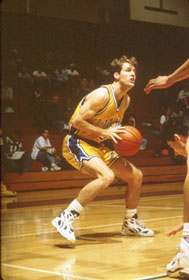 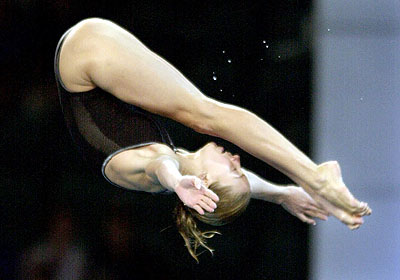
|
|
|