|
|
| |
 |
| Communicating in Words | |
| | |


Our
Mirror Neurons Prefer the Movements We’ve Already Learned
Another category of neurons present
in area F5, canonical
neurons, may, like mirror neurons, be involved in human language
faculties. The special characteristic of canonical neurons is that they fire when
an individual simply sees a graspable object. For example, if a monkey looks at
a ball, the canonical neurons that fire are the same ones that will fire if the
monkey decides to actually grasp the ball. In contrast, the monkey’s mirror
neurons will not be activated by the mere sight of a ball, but only if the monkey
either grasps the ball or sees another monkey do so. | |
|
| ARE MIRROR NEURONS THE BASIS FOR COMMUNICATION? |
| Mirror neurons were discovered
in area
F5 of the ventral premotor cortex of macaque monkeys by researchers at the
University of Parma, Italy, in 1992. The researchers found that these neurons
had some
very distinctive characteristics: they fired not only when a monkey performed
a voluntary gesture (for example, turned a handle to open a door), but also when
a monkey watched another monkey perform this same action.
 | In
essence, mirror neurons react to visual stimuli that represent an interaction
between a biological means of action (such as the hand or mouth) and an object.
These neurons thus act as agents for recognizing purposive actions as opposed
to simple movements. Even in the case of canonical neurons, which can be activated
by the sight of a graspable object in the absence of movement (see sidebar), the
internal representation is that of a purposive action, and not just a simple movement
of the hand or arm. | This is what
has led some researchers to think that mirror neurons might help to explain the
cognitive foundations of language, by providing the neural substrate for the human
ability to understand the meaning of other people’s actions, which is the
basis for all social
relations . This system of correspondences between perceptions and actions
would help us to infer
other people’s mental states and to interpret their actions as intentional
behaviours arising from these states. We can then easily imagine how this mechanism
for interpreting gestural communication might have been applied to verbal communication
as well.
The hypothesis advanced is that the motor system, through its
mirror neurons, is involved in perceiving speech, and that through evolution,
the “motor resonance”generated by the mirror neurons has been diverted
(or exapted)
from its original function to serve the needs of language. One has to be impressed
by the economy of such a cognitive system, in which one individual understands
what other individuals are doing (or saying) on the basis of the internal representation
of his or her own motor capabilities.
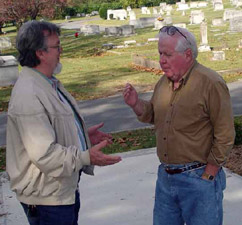
| The point is that intentional communication
between two individuals differs from the simple cries of alarm by which animals
signal danger to all members of their group indiscriminately. Intentional communication,
in contrast, requires one individual who is transmitting information and a second
who is paying attention to receive it. Among all
the possible origins of language, the first form of intentional communication
among humans may have arisen from the imitation of gestures and facial expressions.
Thus mirror neurons may have played a role in sharing these common representations
and, eventually, a common language. | |
|
|