| |

Our most primitive behaviours (like
our reflexes) are concerned with the present. These are the only kind of behaviours
in which reptiles and all the other less evolved animals can engage. In
humans, our learned behaviours add our past experience to our present
actions. Behaviours of this kind did not really begin to develop until the first
mammals emerged. Our imagined behaviours respond to the present through
past experience, by anticipation of the future result. Though present in rudimentary
form in other primates, imagination is the most specifically human characteristic. |
| |
Whatever behaviour
we initiate, be it drinking, playing, reading, making strategic alliances, or
making eyes at someone, it is always because we are subjectively feeling certain
needs. On the psychological level, these needs
generate a state that we experience as a motivation to act. But
an endogenous motivation is not enough to reach the threshold that triggers action.
Likewise, not every external stimulus that is meaningful to us will necessarily
trigger a behaviour. A behaviour will not occur unless
there is a concordance between the two. If you are not feeling hungry, you will
not eat that roast that’s just coming out of the oven. And even if you are
feeling hungry, you will not sit down at the table if there is nothing to eat. The
following diagram shows how a specific situation leads to a specific neural activity
pattern in a person’s brain that in turn leads to a specific behaviour. 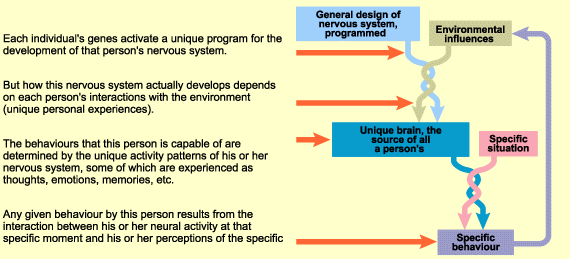
Credit: Jacob L. Driesen
Note
how the specific behaviour goes back and modifies this person’s environment,
which in turn affects this person’s brain. Thus, even outside the organism,
we find the same kind of feedback loops that are essential to its internal functions. 
As
far as the ultimate
origin of behaviours is concerned, you will have to go back to the origins
of the universe itself to find the answer!
|
|